The MoonPhase Approach
A Pattern-Based Approach to Women’s Mental Health, Women’s Whole Health Education & Life Transition
Michele Whitaker, MSN, APRN, PMHNP-BC, C-RYT
Board Certified Psychiatric Mental Health Nurse Practitioner
Integrative Women’s Health Provider Certification
Women’s Mental Health Specialist Certification
Nutritional Psychiatry Certification
Certified Hatha Yoga Teacher
MoonPhase Founder & Clinical Lead
Michele Whitaker is a board-certified Psychiatric-Mental Health Nurse Practitioner (PMHNP-BC), a Certified Women’s Mental Health Specialist and a Certified Integrative Women’s Health Provider. She also has advanced training in menopause-informed care. With more than 32 years of experience in psychiatric nursing and women’s mental health, she brings a deeply informed, whole-person perspective to reproductive transitions, midlife, and the many places where mental and physical health intersect.
She is the founder of MoonPhase Integrative Psychiatry & Wellness, a women’s mental health and wellness practice offering psychiatric care, menopause and whole-health education, professional education, and nonclinical rites-of-passage experiences.
Michele’s work centers on women’s mental health, with particular depth in reproductive transitions and midlife—times when mood, sleep, anxiety, cognition, desire, energy, identity, and physical wellbeing may shift together in ways that are difficult to separate or explain.
Her psychiatric work is menopause-informed and whole-person, drawing from conventional psychiatric care alongside integrative, nutritional, lifestyle, functional, and complementary considerations when clinically relevant. Evaluation and treatment may consider reproductive stage, medication response, sleep, metabolism, medical history, laboratory findings, nervous-system patterns, relationships, environment, and the circumstances in which change emerged.
MoonPhase grew from Michele’s recognition that women’s health and mental health deserve more than a symptom checklist—and that the rhythms of a woman’s life are part of the clinical and human story.
A woman’s health and life unfold through intersecting rhythms-hormonal and neurobiological, emotional and relational, cyclical and seasonal, developmental and deeply personal. These rhythms are not always linear, predictable, or aligned with external timelines.
Across the MoonPhase pathways, there is space to notice what is changing, when it is changing, what may be shaping the experience, and how each woman understands and experiences that change.
The work honors the science of transition—the changing relationships among hormones, brain, body, nervous system, health, and environment—while leaving room for what cannot be reduced to biology alone: identity, relationship, loss, desire, meaning, emergence, and becoming.
Michele believes women are best met where they are. Sometimes that means psychiatric evaluation and treatment. Sometimes it means education and mapping, a broader exploration of health and wellbeing, or simply having a meaningful transition witnessed and intentionally marked. The pathway may differ, but the underlying principle remains: begin with the woman, notice the pattern, and respect the pace and nature of change.
There is an element of accompaniment in this work. Not directing a woman across a threshold, but walking beside her as what is changing, ending, emerging, or asking to be understood becomes more visible.
Michele has advanced training in women’s mental health, reproductive transitions, menopause-informed care, sexual health, integrative psychiatry, nutritional psychiatry, and evidence-based menopause care for nurse practitioners. She is also a certified Hatha Yoga and Laughter Yoga teacher. These complementary disciplines inform a broader appreciation of embodiment, movement, connection, and wellbeing while remaining distinct from psychiatric evaluation and treatment.
At the center of Michele’s work is deep respect for the intelligence of women’s bodies, the complexity of lived experience, and the threshold nature of change. She approaches these transitions with curiosity, presence, and a sense of awe for the ways biology, rhythm, relationship, experience, and meaning can converge—and for what may become visible when they are allowed to remain connected.

-
Board Certified Psychiatric-Mental Health Nurse Practitioner, PMHNP-BC — American Nurses Credentialing Center
Licensed Advanced Practice Registered Nurse — Massachusetts and Florida
Massachusetts Controlled Substance Registration
DEA Registration
-
The Menopause Society (NAMS) member
International Society for Nutritional Psychiatry Research (ISNPR) member
Massachusetts Association of Advanced Psychiatric Nurse Practitioners (MAAPN) member
Massachusetts Coalition of Nurse Practitioners (MCNP) member
Florida Nurse Practitioners Network (FNPN) member
American Association of Nurse Practitioners (AANP) member
-Functional Medicine & Lifestyle Medicine
-Psych Mental Health
-Women's Health
-Entrepreneur Network for Research
Association of Psychiatric Mental Health Nurse Practitioners (APMHNP) member
National Nurse Practitioner Entrepreneur Network (NNPEN) member
International Association of Premenstrual Disorders (IAPMD) member
PostPartum Support International (PSI) member
WorldLink Medical Forum member
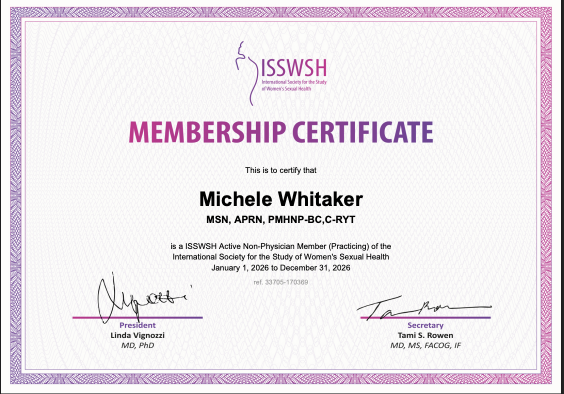
International Society for the Study of Women’s Sexual Health (ISSWSH) member
Reproductive Health Access Network (RHAN) member
-
Mentor, Sigma Theta Tau International Honor Society of Nursing
Mentor, American Psychiatric Nurses Association [APNA]
Mentor, American Nurses Association [ANA]
Beyond The Script Society (member)
Clinical Preceptor for Psychiatric Mental Health Nurse Practitioner Students
Affiliated program: Walden UniversityAdvisory Council Member, American Psychiatric Nurses Association [APNA]
Scope & Standard of Psychiatric Mental Health Nursing Practice Council Advisory Panel
Council for Mental Health Advocacy Advisory Panel
Education Council Advisory Panel
Complementary & Alternative Advanced Practice Mental Health Care Advisory Panel
Rooted PMHNP Mentorship ( member)
-
Sigma Theta Tau International Honor Society of Nursing- Inducted member
National Society of Leadership and Success-Inducted member
Golden Key International Honor Society- Inducted member
-
Bringing women's health and psychiatry into conversation.
Contributing to professional education at the intersection of women's mental health, reproductive psychiatry, and integrative care.
Drawing on more than three decades of experience in behavioral health, addiction treatment, clinical leadership, and advanced practice nursing, her educational work encourages thoughtful clinical inquiry, interdisciplinary collaboration, and care that recognizes both the evidence and women's lived experiences.
Featured Presentation
The Q Spot | November 16, 2026
Periods, Pills & PMDD: When the Clinical Picture Evolves
An advanced educational session for women's health clinicians exploring the complexities of PMDD, including hormone sensitivity, medication management, overlapping psychiatric presentations, emerging research, and integrative approaches.
Areas of Educational Focus
Premenstrual disorders and reproductive psychiatry
Perimenopause, menopause, and mental health
Hormonal transitions and psychopharmacology
ADHD, neurodivergence, and reproductive transitions
Sexual wellbeing and psychiatric care
Integrative approaches to women's mental health
Interdisciplinary clinical collaboration
Clinical Education
Her approach to education emphasizes clinical curiosity, critical thinking, and the integration of evidence with individual patient experiences.
Why MoonPhase
MoonPhase reflects a cyclical view of Women’s Mental Health.
Midlife often changes thresholds-what your system can tolerate, recover from, and carry without cost. What has been muted, managed, or overridden for years can become harder to ignore.
Sleep, mood, anxiety, cognition, desire, stress physiology, and identity may all begin shifting at once. When these changes are treated separately, the pattern can be missed.
At MoonPhase, the work begins by bringing the pattern into view.
Hormones, sleep, metabolism, nervous system load, desire, and identity do not move in straight lines. They move in rhythms and waves-monthly, seasonally, and across life stages.
MoonPhase was created to recognize these rhythms, help women make sense of what they are noticing, and support greater clarity, precision, and coherence
MoonPhase Wellness offers four distinct pathways, each with its own purpose, scope, and availability.
Across perimenopause, menopause, and post-menopause, the brain and body are renegotiating
What image, role, threshold, grief, desire, or awakening is asking to be understood?
Symbolic & Reflective Tools
Some women also benefit from reflective tools that help give language to the deeper identity, relational, and meaning-based shifts of midlife.
When clinically appropriate and personally meaningful, MoonPhase may incorporate journaling prompts, archetypal reflection, seasonal or lunar imagery, values clarification, and narrative exploration to support therapeutic insight and personal integration.
These tools are optional, reflective, and non-diagnostic. Their use depends on the pathway and purpose of the service and does not substitute for medical or psychiatric evaluation when clinical care is indicated.
Coming Into MoonPhase
Many women arrive at MoonPhase with language that is hard to organize at first. The concern may not be one single symptom, but a constellation of changes in mood, sleep, anxiety, attention, desire, energy, nervous system load, daily capacity and self-recognition.
Does Any of This Feel Familiar?
Women often describe experiences like these:
“I haven’t been feeling like myself.”
“My mood, sleep, or focus seems to change with my cycle.”
“I’ve done therapy and made changes, but I still feel like something is being missed.”
“My medication doesn’t seem to work the way it once did.”
“I’ve been told my labs are normal, but I still don’t feel right.”
“These changes seem connected, but no one has helped me understand how.”
“I’m tired of being rushed, dismissed, or told this is just something I have to live with.”
“I want what I’m experiencing—and what I know about my own body—to matter.”
Midlife may be a recalibration of what can no longer continue as before.
What This Practice is Built For
MoonPhase is built for women who sense that something is shifting and want a place to understand the pattern—whether they are seeking psychiatric care, menopause-focused education, broader whole-health education, or intentional support through a meaningful life transition.
Sexual Health Is Part Of The Larger Pattern
Changes in desire, arousal, orgasm, pain, comfort, and sexual wellbeing may reflect the intersections among mood, medication, hormones, relationships, identity, physical health, and life transition.
Room for What Is Emerging
Changes in desire, pleasure, and sexual expression can be tender to name—even when they feel welcome. Some women are noticing a loss or shift; others are discovering new curiosity, desire, or pleasure. Some are still finding words for their experience.
Wherever you are in that discovery, MoonPhase offers a place to begin. You can bring what you have noticed, what you wonder about, or what you are not yet ready to define. We will meet your experience with care, curiosity, and respect for your own understanding of it.
Inclusive Care and Identity-Affirming Support
MoonPhase is centered on women’s mental health with particular attention to reproductive and midlife transitions, and welcomes women across identities, backgrounds, neurotypes, relationships, and sexual experiences. MoonPhase is grounded in inclusive, sex-positive, and identity-affirming care. LGBTQ+, transgender and gender-diverse, neurodivergent, polyamorous and ethically non-monogamous individuals are warmly welcomed, as are those seeking kink-aware care.
Gender, sexuality, neurodivergence, consensual practices, and relationship structures are respected as part of each person’s lived experience.
Care is guided by the individual’s concerns, goals, autonomy, and sense of wellbeing.
When a person’s needs extend beyond the practice’s areas of expertise, this will be discussed transparently, and options for thoughtful collaboration or referral will be considered together.
The Clinical Lens Within Women’s Mental Health Care
MoonPhase helps bring these patterns into view-
Illuminating the biology shaping midlife
Clinical Integrity & Professional Standards
MoonPhase is grounded in established standards of psychiatric practice, ethical prescribing, complementary approaches, and responsible clinical documentation. Care is informed by ongoing professional education, risk-management training, and continued advancement in women’s mental health, reproductive psychiatry, menopause-informed care, and integrative practice. This commitment to lifelong learning supports care that remains thoughtful, current, transparent, and well structured. When appropriate, care also includes consultation, collaboration, and referral to other clinicians whose expertise may better address needs outside MoonPhase’s scope.
Selected training includes:
Certified Women’s Mental Health Specialist
Certified Integrative Women’s Health Provider
Menopause Management for Nurse Practitioners
Nutritional Psychiatry Certification
Motivational Interviewing (MI) Certification
Somatic and Limbic System-based training
Certified Hatha Yoga Teacher
Certified Laughter Yoga Teacher
Certified Usui Reiki l/ II Practitioner
RiskFit® Essentials for Health Professionals Certification
RiskFit® Essentials for Advanced Practice Registered Nurses Certificate
Practice Details
MoonPhase Wellness offers four distinct pathways, each with its own purpose, scope, and availability:
Women’s Mental Health Care— psychiatric care provided to women located in Massachusetts & Florida; and is primarily offered by tele-health, with limited in-person availability when appropriate and scheduling permits.
MoonPhase also offers complementary educational and nonclinical pathways, each with its own scope and availability.
The MoonPhase framework is informed by current literature in women’s mental health, menopause, psychiatry, and neurobiology, together with clinical training and experience in reproductive transitions and integrative care.
a woman’s rhythm may show up through mood, sleep, cognition, reproductive stage, medication response, and symptom timing
Limited hours | By appointment only
Menopause Mapping & Education — nurse-led education available virtually where MoonPhase is authorized to provide registered nursing services
a woman’s rhythm may be expressed and show up through cycles, transitions, patterns, and changing needs.
Women’s Whole Health & Wellness Education— broader nurse-led health and wellness education available virtually where MoonPhase is authorized to provide registered nursing services
a woman’s rhythm may emerge through energy, sleep, movement, appetite, sexuality, stress, and daily capacity
Women’s Rites of Passage — nonclinical transition support available virtually, with select in-person offerings in New England & Florida
A woman’s rhythm may become visible through voice, timing, endings, emergence, threshold, and the pace of transformation
MoonPhase recognizes that women’s lives and bodies move in rhythms—biological, emotional, relational, seasonal, and developmental. These rhythms are not always linear, predictable, or easily separated from one another.
Across all four pathways, the work begins by noticing what is changing, when it is changing, and what the woman herself is experiencing within that movement.
The aim is not to force every experience into a fixed timeline or single explanation, but to create enough space to understand the pattern, respect the pace of change, and respond in a way that fits the woman and the threshold she is moving through.
Each pathway is intentionally distinct. Some are clinical, some educational, and some nonclinical. Women may enter through the pathway that best reflects what they are seeking and may move among MoonPhase offerings over time when appropriate.
Begin where you are
Explore the pathway that fits what you are seeking
Women’s Whole Health & Wellness Education
You do not need to know exactly which pathway is right for you before reaching out. Requests are reviewed to help identify the most appropriate next step, which may include a discovery call, psychiatric evaluation, educational consultation, or Initial Rites Consultation depending on the pathway and fit.
What Happens After You Submit a Consult Request
Requests are reviewed to help identify the most appropriate next step. Depending on the pathway, that may include a discovery call, educational consultation, psychiatric evaluation, Initial Rites Consultation, scheduling information, or referral guidance.
All prospective clients begin by submitting the Consultation Request Form before scheduling.
MoonPhase reviews each request with care and discretion.
If what you are seeking aligns with MoonPhase’s scope and current availability, you will receive information about the appropriate next step.
If another type of service or level of care appears better suited to your needs, MoonPhase will let you know and may recommend another resource or clinician when appropriate.
Submitting a request does not establish a provider-patient relationship or guarantee acceptance into a MoonPhase service.
MoonPhase does not provide emergency or crisis services. If you are experiencing acute distress, thoughts of self-harm, or a medical emergency, call 911, go to your nearest emergency department, or call or text 988.
-
Consider mood, sleep, anxiety, cognition, stress physiology, desire, and neuroendocrine change together—rather than isolating a single symptom
-
Consider biological contributors that may influence psychiatric symptoms, including inflammation, metabolic function, nutrient status, circadian rhythm, and hormonal signaling.
Women can also schedule a one-time menopause-informed psychiatric evaluation to better understand sleep, mood, and hormonal contributors. Ongoing treatment is available but not required.
-
Offer Thoughtful Psychiatric Care and Therapeutic Support
Paced for depth rather than volume.
Ongoing treatment is available but not required.
-
When clinically appropriate, MoonPhase may also review vitamins, minerals, omega-3 fatty acids, botanicals, and other evidence-informed nutraceuticals or supplements that may intersect with mood, sleep, cognition, reproductive transitions, or medication response. Recommendations are individualized and considered alongside medications, medical history, laboratory findings when available, safety, and the strength of supporting evidence. -
So you understand what is shifting and what to do next.
-
Build clarity, capacity, and agency through education, collaborative clinical reasoning, and whole-person treatment planning

-
As estrogen and progesterone signaling changes, it can reshape how the nervous system responds to stress and threat through pathways involving serotonin, dopamine, GABA, and pain processing.
These shifts may heighten physiological sensitivity, but fear, anger, and distress may also carry important information about safety, relationships, boundaries, loss, inequity, or what can no longer be sustained. MoonPhase asks not only how a feeling is arising, but what it may be responding to
-
Changes in neurotransmitter balance can affect focus, motivation, pleasure, and reward sensitivity. Many women describe it simply as: “I’m not myself.”
It may take more effort to concentrate, initiate tasks, feel drive, or access the same baseline joy and steadiness.
-
Midlife can also involve a shift in metabolic resilience-fatigue, afternoon crashes, reduced mental stamina, slower recovery from stress. This is where we consider contributors like insulin sensitivity, thyroid changes, inflammation, micronutrient status, and the body’s overall “energy economy”.
-
Sleep disruption can mimic or magnify anxiety, depression, and ADHD symptoms-and is often the first domino.
Common patterns include 3 a.m. waking, adrenaline surges, night sweats, vivid dreams, and a body that won’t fully downshift.At the same time, sexuality and identity may shift: desire may diminish or fluctuate; body image, grief, anger, disorientation, and relational dynamics can intensify. Pleasure is deeply connected to sleep, stress, relationship, and self-perception-not just hormones.